
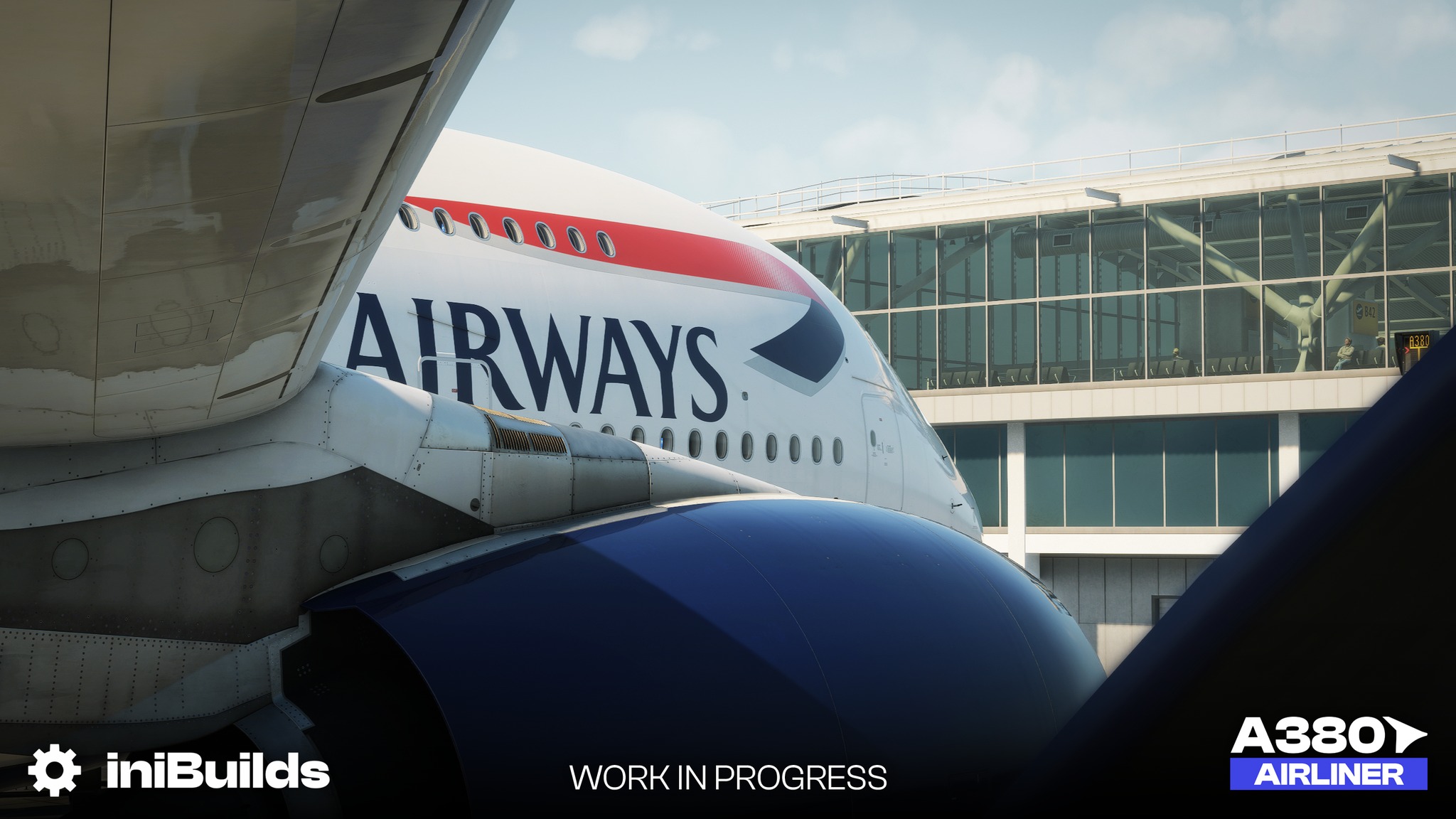
We’ve shared a new development update covering the latest progress on our upcoming A380 Airliner, with work continuing across systems, flight dynamics, ground operations, visuals and more.
A major focus has been on increasing the depth of the simulation. The A380 now features aircraft-state persistence, retaining elements such as fuel quantities, switch positions and system conditions between simulator sessions. Potable water and waste are also fully simulated and persistent, including consumption, accumulation and ground servicing. Turnarounds are further supported by our Multi-Jetway Technology, allowing multiple passenger boarding bridges to connect simultaneously at compatible airports.
The EFB and OIS have received significant development as well. Take-off performance calculations include V-speeds, FLEX temperature and stop margins, with support for intersection departures. We’ve introduced the initial NSS Avionics domain, improved chart handling, added an EFB Notification Centre and upgraded our GSX integration to V2, including dedicated notifications and a panel for monitoring ground-service operations.
Inside the flight deck, the A380 includes independent Display Unit management, a fully integrated Runway Awareness and Advisory System (RAAS) and Brake to Vacate (BTV) functionality. We’ve continued refining the fly-by-wire system and Vertical Situation Display, while the weather radar now makes use of simulator API improvements to provide adjustable tilt and azimuth. Fuel temperature is also dynamically simulated across the aircraft’s tanks and can trigger the appropriate ECAM indications when operating limits are exceeded.
The flight model has also received considerable attention. The complete landing-gear configuration is represented, including functional body-gear steering, individual gear response using MSFS 2024’s suspension modelling and additional contact points, and dedicated A380-specific fly-by-wire rotation laws. The wings use a custom dynamic wing-flex system, responding continuously to aerodynamic forces, aircraft weight, turbulence and manoeuvring loads rather than relying on a predefined animation.
Failures are being expanded through a comprehensive ATA-based failure-management system, including scenarios such as engine fuel leaks, gradual cabin pressurisation leaks and individual Display Unit failures. Events can be configured to occur immediately or randomly during a flight.
We’ve also revealed that pilots will be able to select between Early-MSN and Modern-MSN configurations, based on Batch 2 and Batch 7 standards respectively. These affect FMS capabilities, flight-guidance logic, displays, protections, procedures and checklist philosophy. Both Rolls-Royce Trent 900 and Engine Alliance GP7200 options are represented as distinct variants, with individual geometry, sounds, start and shutdown behaviour, spool dynamics, thrust response and relevant system behaviour.
Finally, exterior work continues with refined wings, engines and fuselage details, interactive Walkaround Mode elements and a range of custom Immersion FX, including water spray, engine vortices, heat blur, contrails, fuel jettison, engine fire and smoke effects, and visual effects for tail strikes.
Read the full development update here.
Comments