
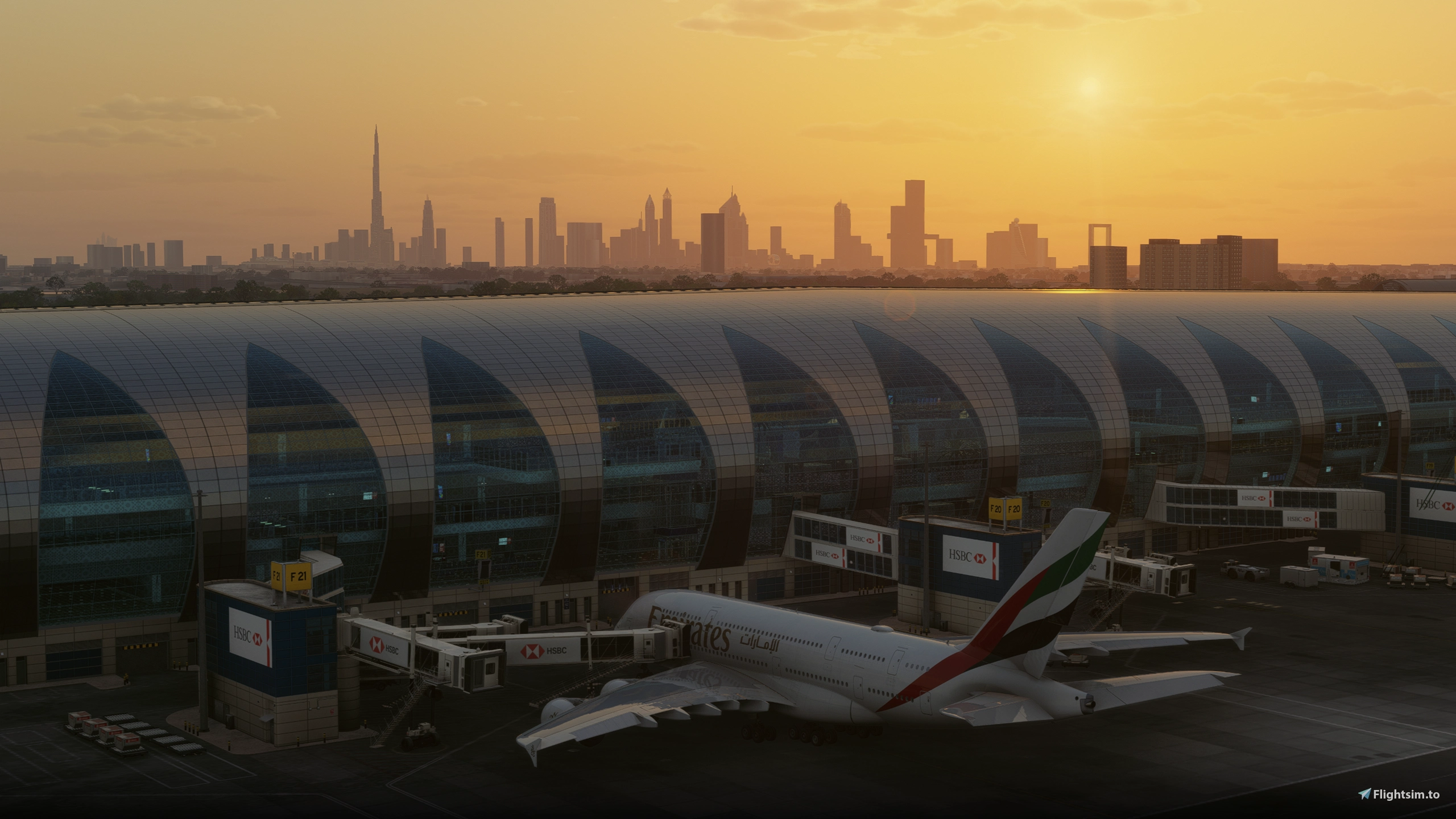
Dubai International has remained one of the most popular airports in the iniBuilds scenery collection since its original release. As one of the busiest international airports in the world and the home of some of aviation’s most recognisable long-haul operations, it is a destination that continues to play an important role in MSFS.
However, the original scenery was created several years ago for Microsoft Flight Simulator 2020. Since then, both the simulator and our approach to scenery development have changed considerably.
Rather than applying a simple visual refresh or compatibility update, the team has been using V2 as an opportunity to revisit the airport throughout. Existing assets have been reviewed, rebuilt or replaced, new areas have been introduced and the entire airport is being prepared specifically around the capabilities of Microsoft Flight Simulator 2024.
One of the first stages of the project involved reviewing the original scenery and identifying where the greatest improvements could be made.
The original Dubai represented the development techniques and simulator capabilities available at the time. Since then, our work on airports such as Chicago O’Hare, London City, Manchester and Malta has allowed us to introduce new modelling methods, more efficient asset workflows and a much deeper understanding of building complex airports for Microsoft Flight Simulator 2024.
V2 allows us to apply those lessons throughout Dubai. This includes improvements to modelling, texturing, terminal geometry, interior spaces, airfield detail, lighting and the wider airport environment. Areas which previously relied on older assets or simplified geometry have been revisited, whilst parts of the airport that received limited attention in the original version are now being developed in considerably greater detail.
Terminal Modelling and Exterior Detail
The terminal complex is one of the most recognisable parts of Dubai International and has been a major focus throughout the V2 redevelopment.
The A, B and C Gates have been completely overhauled, with updated modelling and newly created interiors throughout. The D Gates have also received a range of improvements, although the existing interior did not require the same level of redevelopment. Elsewhere, the ATC tower has been enhanced with improved modelling, updated artwork and additional surface detail.
Updated geometry and materials allow the terminal buildings to more closely reflect their real-world appearance, bringing greater depth to the building faces, roof structures, glass surfaces, gate environments and surrounding service areas. These improvements are particularly noticeable around the stands, where aircraft operate close to the terminal buildings and even the smallest details contribute to the overall experience.
Expanded Interior Environments
Terminal interiors are another area where the difference between the original scenery and V2 will be immediately noticeable.
Areas that previously featured limited or simplified interiors are being revisited with more complete passenger spaces, improved materials, updated lighting and additional detail visible from both the apron and inside the terminal.
Airfield and Ground Environment
Away from the terminal buildings, the wider airfield has also received significant attention. Ground textures, markings, taxiway environments, service roads and apron areas have been reviewed and updated to better represent the current airport. Additional clutter, vehicles and ground equipment help give the airfield a greater sense of activity, particularly across the expansive apron areas surrounding the terminal complex.
The surrounding airport environment has also been expanded with an extended Metro line, an animated shuttle train serving the D Gates and an animated fountain near the Dubai Airport Freezone. Airport lighting has undergone a complete overhaul, alongside numerous improvements and bug fixes based on feedback from the community.
Several new structures have also been introduced throughout the wider airport environment, including multiple underpasses and elevated roads, new Emirates car parks and headquarters parking, additional auxiliary buildings, and a new mosque within the Terminal 3 parking area.
Dozens of performance optimisations have been implemented throughout the scenery, including reduced node and vertex counts, fewer draw calls, improved bounding-box sizes, greater use of simulator props across the terminals and further LOD improvements. Almost everything raised within the feedback document has now been addressed, with the exception of static private jets, which can conflict with community traffic configurations.
A considerable amount of work has also taken place to improve performance across the airport. This includes the use of vert limits, LOD optimisations and the use of SimProp Containers.
Large sections of the airport have been rebuilt and optimised to reduce unnecessary node counts, vertices, draw calls and bounding boxes. The scenery also makes much greater use of our latest Level of Detail workflows, allowing complex assets to be displayed efficiently depending on their distance from the aircraft.
For a project of Dubai’s scale, this work is especially important. The airport combines extensive terminal buildings, large numbers of stands, detailed interiors and a dense surrounding environment, all of which must remain manageable throughout arrival, departure and ground operations.
The result will be an airport that is not only more detailed than the original, but also built from the outset around the capabilities and requirements of Microsoft Flight Simulator 2024.
Multi-Jetway Operations
Dubai International is one of the most recognisable homes of the A380, making it the perfect airport for our Multi-Jetway System!
At selected compatible stands, multiple passenger boarding bridges will be able to connect to a single aircraft simultaneously, creating a much more authentic turnaround experience for large widebody operations.
The system will operate in the same was as other airports that have already received this feature, such as Hong Kong, Gatwick and Chicago.
Compatible aircraft will therefore be able to use multiple jetways in much the same way as the default passenger boarding bridges, helping the feature feel like a natural extension of the existing simulator experience.
Although especially fitting for A380 operations, the system will also add further authenticity when operating other compatible widebody aircraft through the airport.
A Free Update for Existing Enhanced Owners
Dubai International Airport V2 will be provided as a FREE update to customers who own iniBuilds Dubai Enhanced, which will be rebranded as iniBuilds Dubai Premium upon release. The existing discounted upgrade path from the MSFS 2020 version to the MSFS 2024 version will be discontinued when V2 launches. Customers who do not already own Dubai Enhanced will therefore need to purchase Dubai V2 Premium at full price.