
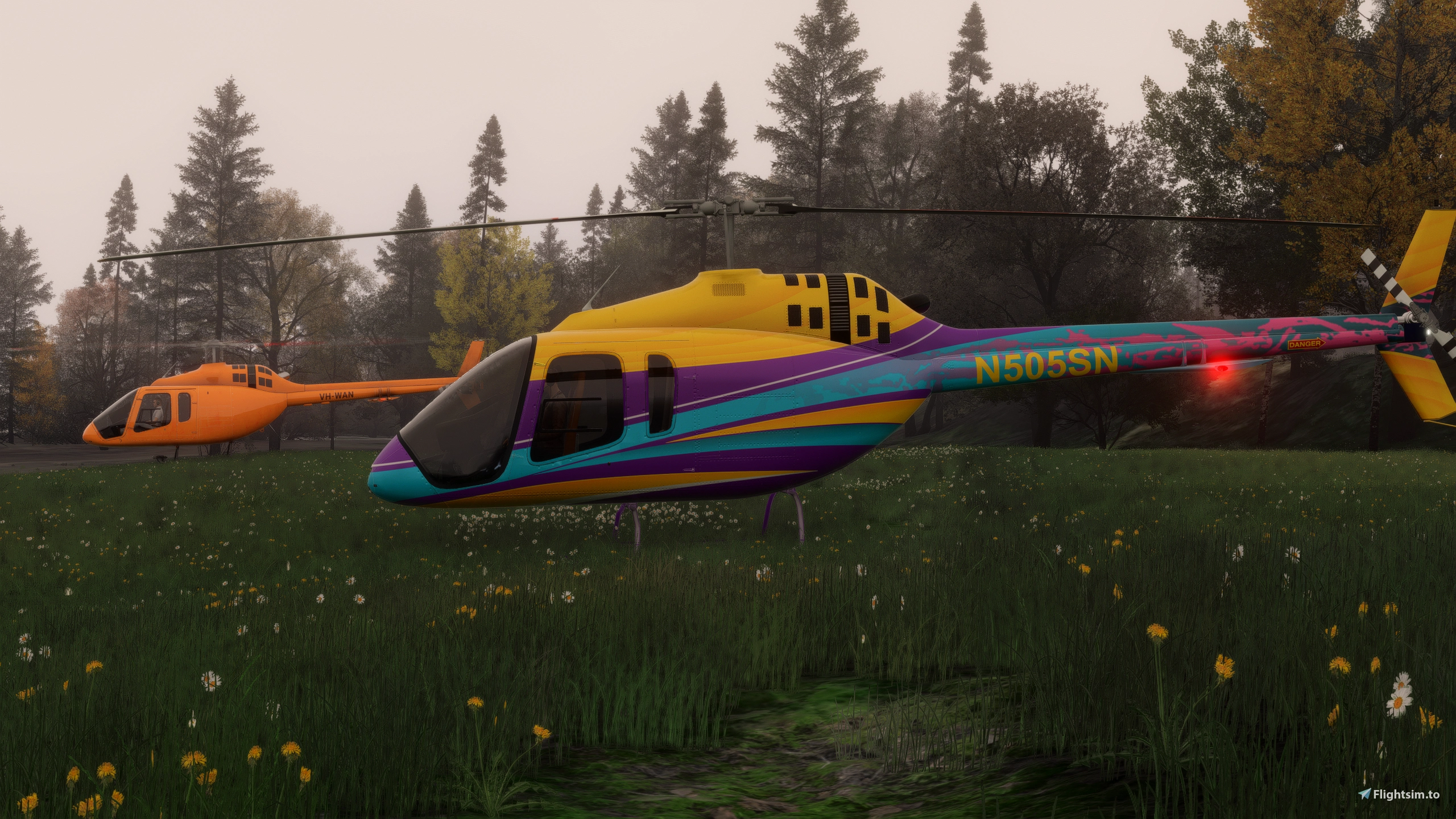
Beschreibung
A realism mod for the jXt Bell 505. It flies by Bell's own book.It won't forgive a sloppy manoeuvre. It's not a sports car, it's a pickup truck.It hovers where Bell says it can, cruises at the speed Bell's charts say it will and burns the fuel Bell says it burns. Push past the envelope and you pay for it. (The power situation indicator is still a WIP but the Q NG ITT and Fuelburn are not xD)
MSFS 2024 still flies the rotor; three WASM modules and a control filter make it answer to the book. The stock rotor, engine and cabin were measured first, and wherever they disagreed with Bell, they were corrected. FREEWARE. BETA. Payware ambition.
Built on Bell's flight manual (RFM), maintenance manual and Specification Book charts, read from the PDF's vectors; published rotor research where Bell publishes nothing; and a 30 Hz, 300-channel flight recorder plus a stopwatch.
🔢 Measured against the book
- Cruise: torque +1.0 % at 110 kt and +0.9 % at 120 kt against the Specification Book charts.
- Hover: 55–57 % torque in ground effect at 3,510 lb against 57.5 % (±2.3); out of ground effect, 59.0 % at 2,785 lb against 59.4 %.
- Engine and fuel: torque 98 % → Ng 101.3 %, the takeoff limit; fuel within ±0.6 lb/h of Bell's map.
- Rotor start: 63 % rotor rpm in 39 s, against 40.1 s in a real Bell 505.
- Roll and pitch: NASA's teetering-rotor method (TM-84281) predicts 2.2 s to roll and 3.4 s to pitch to 90°; the stopwatch agrees.
- Control response: the simulator's own rotor response is identified live in flight and checked against three logged flights: 8 of 9 speed bands within tolerance.
🌀 Rotor: two blades, flown like two blades
The rotor moves first, the airframe follows, and the rotor then brakes it. Pull collective and the cyclic bites harder; unload the rotor and it goes quiet in your hand.
- Geometry: 18.5 ft, two blades, 369 rpm, governed at 104 % in FLY, −11° twist. Full cyclic = 9° of blade pitch, confirmed in flight against the maintenance manual.
- Airfoil: Bell doesn't publish the polar, so it comes from NPL and NACA wind-tunnel data: stall at Cl 1.22 / 13.5°, read back in the sim as 1.21 / 13.6°.
- Teetering response (NASA TM-84281): two stages between your hand and the airframe. The blades flap to the new disc tilt in a time set by rotor speed and air density; then the airframe follows the tilted disc in a time set by its inertia and the live rotor thrust. Nothing in it is a fixed table: thrust, rotor rpm, density and the simulator's own response are read every frame.
- Load factor is real: the control moment is thrust times lever arm. More collective, more thrust, more cyclic authority. Zero g, no cyclic authority: the disc tilts, the airframe does not follow.
- Collective: no negative thrust at the bottom; autorotation at 60 kt, 1,800–2,200 fpm with the rotor at 104 %. The tail rotor has its own stall.
- Empty-weight CG to the RFM: 2,180 lb at FS 177.5; pilot alone with full fuel sits inside the aft limit.
📖 Flight Dynamics
The torque gauge tells the truth: heavy and hot, the hover eats your margin; gather speed and it gives some back.
- Hover and transition: the sim hovers on ideal power (factor 1.04); Bell's ceilings need 1.44. Classic rotor theory closes the gap, and Bell's twelve cruise charts take over from 40 kt.
- Ground effect: near the ground the air carries you; tilt the rotor and the cushion weakens. The same law on the skids as in the air, so a touchdown is a touchdown, not a bounce.
- Translational lift: the sim's rotor sheds 5–8 % torque with speed, the book about 30. Lever held still from 0 to 81 kt: torque 70 → 53.5 → 60 %, no sink.
- Nothing is free: climbs cost power, descents give back only part of it; dropping the nose buys no lift.
- Pull g and it bills you: the lift correction is gone by 1.30 g, inverted or with the rotor drooping. Hard turns cost speed: 2 g at 100 kt costs 82 hp, about 1.7 kt every second.
- It knows its state: attitude, rates, height, airflow over the fuselage, wind in body axes, direction of flight and flight phase, one coherent block every physics step. The module identifies live how the simulator's own rotor answers the stick, as a continuous function of speed, load factor and height, and the control filter uses only what the simulator does not already do.
- It learns slowly, in steady 1 g flight only, and remembers from one flight to the next.
🌪️ Vortex ring state (VRS)
Come down slowly and steeply and you settle into your own downwash. No manufacturer publishes a VRS chart; this is Wayne Johnson's NASA model (AHS 2004), scaled live by weight and air density. Heavier or higher, the ring moves to faster entry speeds and descents. More collective digs you deeper; cyclic is the way out. The sim's VRS helper is off.
🔥 Engine and FADEC (Arrius 2R)
Ng is the engine's core speed, MGT its temperature, PSI the single gauge that says how close you are to the limit.
An engine with limits and a temper, and a start you can time with a watch.
- Ng and MGT from Bell's Power Assurance Check chart (781 points), and still right when you fly colder, hotter or higher than the chart. Not the sim's own gauges.
- Start: MGT peaks at 670 °C at light-off and settles at 503 °C; IDLE → FLY in 13–15 s.
- Fuel burns by the Specification Book charts, not the sim's engine.
- Limits: torque 90 / 100 / 105 %, Ng 99.8 / 101.2 / 103.6 %, MGT 817 / 853 / 882 °C. Whichever comes first; a drooping rotor gets one short transient; below 97 % rotor rpm, the call is yours. PSI 3 / 5 / 10 as in the manual.
❄️ Cabin, oil and systems
Winter is a system.
- Heat costs 34–42 hp of bleed air, from the RFM. On a mild day it will cook you: open the vent.
- Fog on five pieces of glass, each on its own. DEFOG clears only the windshield; on a very cold day it may be the only glass you see through. Open the vent while heating and the cabin dries and every window clears, at the cost of a colder cabin.
- Oil: one radiator, two circuits, a blower on the tail-rotor shaft, thermostatic valves. Work in progress: it doesn't answer to outside temperature yet; on a hot day, idling on the ground should overheat it.
- Electrics and hydraulics on the native solvers with the real topology; the hydraulic pump turns with the rotor, so the controls are heavy during the start.
🧭 G1000H and tablet
- Working Title G1000 for navigation, with Bell engine pages fed by the FADEC, dynamic Vne from the RFM placard, a slip bar that actually moves, Power Assurance Check and weight and balance.
- Bell 505 power-up screen from a cold start, as in the Pilot's Guide, then weight and balance.
- Terrain: the Vertical Situation Display draws the ground ahead, and HTAWS calls "Terrain, Terrain" when it should. One voice for all 36 alerts, CAS pings and voices, the 150 ft callout, Traffic Advisory voice (still too quiet about traffic, only very close ones; rework due).
- New in 1.0.7, please try it and tell: the Bell 505 power-up screen from a cold start, the terrain on the VSD, and the AUD Test (MFD, Engine > Test): it plays every alert sound in the order of the Pilot's Guide, shows the CAS messages and spins the avionics fans up. Fly a valley with HTAWS on and listen for the new voices. Say what sounds right and what doesn't.
- The B505 Config tablet loads passengers, baggage, fuel and equipment on the 14 RFM stations, saves per livery, and puts back the passengers the sim wipes.
- Too many voices? Mute them from the MFD. Turn the small FMS knob to the last page group (AUX / MAP pages at the end), open the terrain page and use its menu: "FLTA inhibit" stops the forward-looking terrain alerts, "Mute CTN" silences the caution voice. The traffic page has its own alert mute in the same menu. The warnings stay on; only what you switched off goes quiet. It also has a reduced mode.
⚠️ Straight talk
"It filters the controls." No. It gives the rotor the time it has in a real two-bladed teetering rotor. The cyclic has a hydraulic actuator: the blade pitch goes where your hand goes, at once, and so does the stick drawn in the cockpit. What takes time is downstream, and the simulator does not model it: the blades have to flap to the new disc tilt (about one rotor revolution), and only then does the thrust, now pointing away from the mast, start to turn the fuselage against its inertia. This mod puts that time where the simulator leaves a door open: its control input. The time constants are not fixed numbers: rotor speed and air density set the blade stage, the fuselage inertia and the live rotor thrust set the body stage, and the module measures in flight what the simulator already does by itself, to add only the difference.
Why through the controls, and not a flight model of its own. MSFS 2024 still flies this helicopter: its blade-element rotor, its masses and inertias, its ground contact, its wind and its atmosphere. None of that is replaced. Where the stock rotor lacks a piece of physics, the mod adds that piece through the doors the simulator leaves open: forces on the airframe from the Flight Dynamics module, and the simulator's own control inputs. Writing a separate flight model would have meant giving up everything the simulator already does well and spending the effort on reinventing it. The choice here is to measure what the simulator does, keep it, and correct only the difference against Bell's book.
That is why collective changes how the cyclic bites: more collective, more thrust, more moment for the same stick, and the airframe reaches your stick position sooner; lower the collective and the cyclic goes soft. Unload the rotor to zero g and it stops steering altogether. You will find yourself anticipating: pull collective, lower the nose; lower collective, raise the nose. That is a real helicopter, not a filter.
Fly it ahead of itself. Make the input, hold it, and wait for the airframe to arrive; then take it out before you are there. If you chase the nose you will build a pilot-induced oscillation, the same one a real two-bladed rotor gives a pilot who corrects late and then corrects more. That is not a bug to report. Smaller inputs, earlier, and a hand that stays still between them.
Not done yet: the rotor's physical flapping limit, mast bumping, is computed and recorded but has no consequence yet; it moves to 1.0.8 (rolls and loops are still possible). Retreating-blade stall; traffic voice that speaks only when traffic is very close; maintenance; oil vs outside temperature; a punishing dive past Vne. MGT reads a few degrees high in forward flight. Fly with the sim's helicopter assistances off.
One pilot, one computer. There is no time to fly every situation on every machine before a release. Bug reports through Discord are appreciated, and so is what you like, what you don't, and why: that opinion is worth a lot here.
Prove me wrong: bring weight, fuel, altitude, OAT, IAS, torque and Ng. "It feels weird" starts the conversation; numbers finish it. 👉 Join the project Discord
📦 Installation
- Close Microsoft Flight Simulator 2024.
- Delete older versions first:
jxt-mzapata-bell505(1.0.5 / 1.0.6),jxtsimulations-aircraft-bell505andjxt-b505-efb-config(1.0.4 or older),jxt-mzapata-bell505-experimental. - Extract
jxt-mzapata-bell505into your Community folder.
Your jXt Bell 505 liveries keep working. Installing means accepting the included EULA.txt.
⭐ Credits
- jXt Simulations / thommoj — the original freeware Bell 505, and the permission to rebuild it.
- Bell Textron (RFM, MM, PGI, Specification Book) · Safran (Arrius 2R, EASA/FAA TCDS) · Red Aviation (startup video).
- Research: Glauert; Heffley & Mnich, NASA CR-177476; Talbot et al., NASA TM-84281; Pitt & Peters; Johnson, NDARC and VRS model (AHS 2004); Cheeseman & Bennett, ARC R&M 3021; NPL 9615, ARC CP 1261; Critzos et al., NACA TN 3361; Prandtl; Padfield; Leishman; Prouty.
- Microsoft & Asobo · Working Title · Navigraph.
- MZ Rotorworks — flight model, FADEC, systems, cabin, G1000H, tablet, testing and hair-loss management.
- Community test pilots, thank you.
- And my beloved and closest one, for the patience :P
🚁🔥 jXt + MZRotorworks Bell 505 Realism Mod + G1000H — Version 1.0.7.9.1 (Custom FM & FADEC)
The freeware Bell 505 that flies by Bell's own book. It won't forgive a sloppy turn or induced oscilations :P. It burns the fuel Bell says it burns. You want a helicopter where the numbers mean something. Where the torque you pull is the torque Bell says you need. Where the engine runs out of breath at altitude exactly where the chart says it will. Where a careless descent drops you into your own downwash and only good flying gets you out. Now It even screams at you "Warning Terrain Terrain"!


Nutzerbewertungen
9 Bewertungen
Versionsgeschichte
1.0.7.9 hotfix: pickup fix, and more flight model improvements. - Pickup fix: lifting off and setting down no longer kicks the cyclic. The airframe stage of the control response reads the weight on the skids continuously (skid compression, not the ground flag), and the load factor it uses is smoothed, so a touchdown bump no longer releases the stored lag all at once. - No more self-steering: the model-following correction that pushed the cyclic on its own with collective and during liftoff is off by default. - More grip on the skids: the simulator's advanced ground-contact model is now always on for the skid points. - Flight Dynamics: the rotor-wake correction follows the actual mast load instead of switching off above 1.3 g or with the disc inverted. - Diagnostics published for testers: rotor force vector and disc angle per axis, skid load fraction, filtered load factor.
Melden Sie sich an, um an der Diskussion teilzunehmen
AnmeldenKommentare(42)
about 18 hours ago
about 12 hours ago
Dieser Kommentar wurde gelöscht
about 12 hours ago
Dieser Kommentar wurde gelöscht
about 12 hours ago
Dieser Kommentar wurde gelöscht
about 12 hours ago
Dieser Kommentar wurde gelöscht
about 12 hours ago
Dieser Kommentar wurde gelöscht
about 11 hours ago
Thanks for the feedback, and apologies, my replies above came out more defensive than intended. Two concrete things: the canopy fogging is the cabin thermal model, vents plus bleed air plus the defog knob clear it, and I’ll make that clearer in the manual. On the handling, SAS/AP are next and I’m considering a simpler mode. If you can tell me which phase feels off, hover, cruise or approach, I can check it against the flight logs.
1 day ago
1 day ago
1 day ago
4 days ago
8 days ago
14 days ago
14 days ago
15 days ago
15 days ago
17 days ago
17 days ago
20 days ago
20 days ago